SYNOPSIS
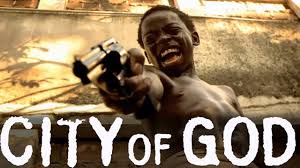
City of God is based on a true story that takes place in the ’60s where in the slums of Rio de Janeiro two boys growing up in the neighbourhood take on different paths in life. The story is told through the eyes of Bus-cape, a poor young fisherman’s son who dreams of becoming a photographer one day. His story narrates the violence and corruption surrounding the city and the rise and fall of one of the city’s most notorious bosses, Li’l Ze . As war wages on the streets Bus-cape’s only way out of this violent life is to expose its brutality to the world through his pictures. Along the way the lives of others are put into perspective as their stories intersect with the events that take place.
DIRECTION STYLE
City of God is a 2002 Brazilian crime film co-directed by Fernando Meirelles and Kátia Lund, released in its home country in 2002 and worldwide in 2003. The story was adapted by Bráulio Mantovani from the 1997 novel of the same name written by Paulo Lins, but the plot is loosely based on real events. It depicts the growth of organized crime in the Cidade de Deus suburb of Rio de Janeiro, between the end of the 1960s and the beginning of the 1980s, with the closure of the film depicting the war between the drug dealer Li’l Zé and vigilante-turned-criminal Knockout Ned. The tagline is “If you run, the beast catches you; if you stay, the beast eats you.”
The plot of the movie unfolds from Buscape’s point of view who tries to tell his own story by explaining the events from the beginning. The way the story develops is non-linear. Initially, the action begins near the end of the film where Buscape finds himself in the middle of an impending conflict which is going to arise. Then, Buscape’s narration gives details and explains the events. Eventually, the movie ends closing its circle of narration after the initial conflict. The main structure of the film is based on flashbacks for the purpose of explaining the main story. It is important to mention that the film uses Buscape as the homodiegetic narrator of the story. Although he is one of the main characters, most of the times he is an observer to the events. As Stephanie Muir states in her book, Studying City of God, Buscape tells the story as a journalist. This can be further explained by mentioning that his narration seems to be objective as a journalist’s because he shows different aspects of the story. However, the fact that the main question that rises in the beginning and that in the narration, Buscape’s feelings are clearly stated in his own words, it is logical to assume that Buscape represents the voice of reason inside chaotic scenery. This is clearly defined from the types of the shots.
This film as a contemporary example of modern Brazilian filmmaking, I hope to have illustrated the social filmmaker’s responsibility to develop considered visual systems placing social realities under relentless scrutiny. Asking ‘why’ and ‘how’ Meirelles made the choices he did, I hope to have also indicated ‘why’ and ‘how’ films based on fact have a vital role to play in society. Conscious observation of history by audio-visual media may lead to a real and current understanding of social dilemmas. Through the understanding of such situations, their reality is made visible and thus shown to be potentially changeable. Meirelles’s visual style communicates the chaotic world bequeathed to a new generation of children by an indifferent society – a world of which they are desperately but unsuccessfully trying to make sense. The viewer is made aware of his/her involvement in the current state of affairs. Society is asked to take responsibility for conditions in the favelas, to act through the observation of history in order to perhaps change the chaotic spiral of such slums across the globe. To end with the words of Arnaldo Jabor.
STORY
The film begins with an armed gang chasing after an escaped chicken in a favela called the Cidade de Deus (“City of God”). The chicken stops between the gang and the narrator, a young man nicknamed Rocket (“Buscapé”).
The film flashes back to the 1960s where the favela is shown as a newly built housing project with little resources. Three impoverished, amateur thieves known as the “Tender Trio” – Shaggy (“Cabeleira”), Clipper (“Alicate”), and Rocket’s older brother, Goose (“Marreco”) – rob business owners and share the money with the community who, in turn, hide them from the police. Li’l Dice (Dadinho), a young boy, convinces them to hold up a motel and rob its occupants. The gang resolves not to kill anyone and tells Li’l Dice to serve as a lookout. Instead, Li’l Dice guns down the motel occupants after falsely warning the trio that the police are coming. The massacre is brought to the police’s attention, forcing the trio to split up: Clipper joins the church, Shaggy is shot by the police while trying to escape the favela, and Goose is shot by Li’l Dice after taking his money while Li’l Dice’s friend Benny (Bené), Shaggy’s brother, watches.
In the 1970s, the favela has been transformed into an urban jungle. Rocket has joined a group of young hippies. He enjoys photography and likes one girl, Angélica, but his attempt to get close to her are ruined by a gang of petty criminal kids known as “The Runts”. Li’l Dice, who now calls himself “Li’l Zé” (“Zé Pequeno”), has established a drug empire with Benny by eliminating all of the competition, except for Carrot, who is a good friend of Benny’s. Li’l Zé takes over ‘the apartment’, a known drug distribution center, and forces Carrot’s manager Blacky (“Neguinho”) to work for him instead. Coincidentally, Rocket visits the apartment to get some drugs off Blacky during the apartment raid. Through narration, Rocket momentarily considers attempting to kill Li’l Zé to avenge his brother but decides against it. He is let go after Benny tells Li’l Zé that Rocket is Goose’s brother.
Sometime later, a relative peace comes over the City of God under the reign of Li’l Zé, who manages to avoid police attention. Benny decides to branch out of the drug dealer crowd and befriends Tiago, Angélica’s ex-boyfriend, who introduces him to his (and Rocket’s) friend group; Benny and Angélica begin dating. Together, they decide to leave the City and the drug trade. During Benny’s farewell party, Zé and Benny get into an argument; Blacky accidentally kills Benny while trying to shoot Li’l Zé. Benny’s death leaves Lil Zé unchecked. Carrot kills Blacky for endangering his life. Li’l Zé and a group of his soldiers start to make their way to Carrot’s hideout with the intention of killing him. On the way, Zé follows a girl who dismissed his advances at Benny’s party; he beats up her boyfriend, a peaceful man named Knockout Ned (Mane Galinha), and rapes her. After Ned’s brother stabs Li’l Zé, his gang retaliates by shooting into his house, killing his brother and uncle in the process. A gang war breaks out between Carrot and Li’l Zé; a vengeful Ned sides with Carrot.
A year later in the early 1980s, the war continues, the origin forgotten. Both sides enlist more “soldiers” and Li’l Zé gives the Runts weapons. One day, Li’l Zé has Rocket take photos of him and his gang. A reporter publishes the photos, a major scoop since nobody is able to safely enter the City of God anymore. Rocket believes his life is endangered, as he thinks Lil Zé will kill him for publishing the photo of him and his gang. The reporter takes Rocket in for the night, and he loses his virginity to her. Unbeknownst to him, Li’l Zé, jealous of Ned’s media fame, is pleased with the photos and with his own increased notoriety.
Rocket returns to the City for more photographs, bringing the film back to its opening scene. Confronted by the gang, Rocket is surprised that Zé asks him to take pictures, but as he prepares to take the photo, the police arrive and then drive off when Carrot’s gang arrives. In the ensuing gunfight, Ned is killed by a boy who has infiltrated his gang to avenge his father, a policeman whom Ned has shot. The police capture Li’l Zé and Carrot and plan to show Carrot off to the media. Since Li’l Zé has been bribing the police, they take all of Li’l Zé’s money and let him go, but Rocket secretly photographs the scene. The Runts murder Zé to avenge the Runt murdered at the behest of Zé; they intend to run his criminal enterprise themselves.
Rocket contemplates whether to publish the photo of the cops, exposing corruption and becoming famous, or the photo of Li’l Zé’s dead body, which will get him an internship at the newspaper. He decides on the latter and the film ends with the Runts walking around the City of God, making a hit list of the dealers they plan to kill to take over the drug business, including the Red Brigade.
EDITING
The overall editing of the film is based on simple cuts, freeze frames, dissolves and fade to black transitions. However, there are specific parts of the film where the editing techniques used improve the plot and the styles of the film by heighten the emotions of the viewer. Specifically, the first scene of the film (the chicken run) which is the most popular one seems to be based on a certain metaphor between the chicken which is running and Buscape who expresses to his friend his fear of Li Ôl Ze. The elements that enhance the narrative development of this sequence are the fast paced editing, the music, the sound effects, the dialogue and the way all those are edited and mixed. To illustrate that, every cut in this scene is made according to the music and the action for the purpose of creating the suspense and shaping the main question of the movie. Furthermore, the opening scene depicts the whole style and the essence of the film predisposing the viewer for the theme of this movie. Automatically, from this point, the viewer knows what is happening but simultaneously the suspense is increasing. However, there are a lot of other scenes where the editing deepens into the story. In the sequence, ‘the story of the apartment’, the narration unfolds important elements of the story in a short amount of time through dissolves. Moreover, in the scene after the gunfire in the hotel where the faculty and the customers lying dead, the tragedy is underlined by the wipe transition from shot to shot.
The editing technique used mainly in the film is called the ‘Kuleshov effect because the meaning in most parts of the film was shaped in the editing room. The most significant examples, except the opening sequence, are the scene where two boys are hiding on the trees from the police when another scene (the scene with the fish) interrupts this one. The same technique is used in the scene where Li Ôl Ze forces the little kid of the gang to kill the other little kid followed by the shot of a dog eating a piece of meat. These juxtapositions of images create the basic meaning of this society: big fish eat small fish
CONCLUSION
“City of God” tells the story of Rocket, an aspiring photographer looking for his big break so he can leave the treacherous area once and for all. The movie chronicles Rocket’s life as a young boy as he deals with his law bending brother and his gang, all the way to his teen years as a pseudo hippie. As the crime level soars in brutality, Rocket begins to realize his niche as a photographer is his only means of staying honest. With a psychopathic thug named “Lil Ze” looking to take over the slum, Rocket’s career will take him on his most dangerous task of all.
 Film Blog