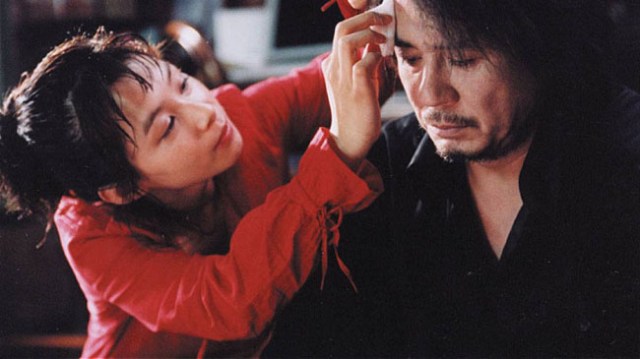
STORY
Oldboy begins in 1988 when the main character, Oh Dae-su (Choi Min-sik), is mysteriously kidnapped on the night of his daughter’s birthday. For fifteen years, Oh Dae-su is confined to a hotel room without reason. His only window to the outside world is a television set. Through the television he learns that his wife has been murdered. In his strange absence he becomes the main suspect. Each day Dae-su practices boxing and attempts escape.
One day, Dae-su is released on the roof of an apartment building. From a small trunk, he emerges into the world. Unable to figure out why he was kidnapped or who kidnapped him, he goes to a sushi restaurant where he meets Mi-do (Kang Hye-jung). Oh Dae-su faints at the restaurant and Mi-do takes him back to her apartment. Upon waking, Dae-su briefly loses self-control and tries to attack Mi-do. However, the two reconcile and become friends. Mi-do agrees to help Dae-su search for his daughter.
They learn that Dae-su’s daughter was adopted by a Swedish family after his wife was murdered. Distraught by the news, Dae-su continues to search for his kidnapper. He tracks down the restaurant that made the dumplings he ate each day in captivity. From there he finds the delivery boy and then the make-shift prison. Returning to the private prison to get information, Dae-su must later fight his way out of the building. The famous fight scene involves Dae-su armed with a hammer against multiple henchmen.
Eventually, Dae-su and his captor meet. His captor Lee Woo-jin (Yoo Ji-tae) gives Dae-su five days to solve the mystery of his imprisonment. If he solves the mystery, Woo-jin will kill himself, if Dae-su cannot solve the mystery, Woo-jin will kill Mi-do. Dae-su and Mi-do work together to understand Dae-su’s imprisonment and in the process fall in love. In a moment of intense passion the two have sex. Dae-su begins to put together the pieces of his connection to Woo-jin, realizing that they both attended the same high school. As a teenager, Dae-su witnessed Woo-jin and his sister’s incestuous relationship. Dae-su then accidentally spreads the rumor of their relationship and Soo-ah (Woo-jin’s sister) commits suicide.
Solving the mystery, Dae-su rushes to Woo-jin’s penthouse apartment. There, Woo-jin reveals that Mi-do is actually Dae-su’s daughter and that he used hypnosis to orchestrate their meeting and attraction. In a moment of extreme anguish, Dae-su cuts out his own tongue, Woo-jin commits suicide, and the penthouse fills with blood.
In a flash-forward, Dae-su is hypnotized again to forget the terrible act he has committed. Dae-su and Mi-do meet again, but the success of the hypnosis is unclear.
DIRECTION STYLE
Oldboy film was directed by Park Chan-wook. This film includes a number of truly shocking scenes and concepts. From the abduction of Dae-su, to his imprisonment for 15 years, to the actual reason behind it, and everything between, are rather shocking. The scene of him eating the octopus, the various bloody fights, the sex scene with his daughter, and the entirety of the ending sequence, definitely provide a shock element, which the spectator does not easily overcome.
However, Park managed to inject his distinct, dark, and ironic sense of humor, in this otherwise onerous setting. During the corridor scene, when Dae-su asks the thugs for their blood type before he hands them a member of their team he had previously hurt. The whole concept of the character, with Dae-su acting like a caricature throughout the majority of the film. His interactions with his kidnapper, in a sequence mocking everything presented on screen concerning this kind of relationship.
This very dark sense of irony finds its apogee in the very end, with Dae-su asking the hypnotist to make him forget that Mido is actually his daughter, in order to return to a relationship he knows is incestuous.
CINEMATOGRAPHY AND EDITING
Chung Chung-hoon’s cinematography does wonders in the presentation of the complexity of the story and the intense aesthetics Park wanted to give the movie. Apart from the corridor scene, Chung uses bright colors, intentional grain, and color saturations, in an effort to match the extreme nature of the story without physically exhausting the audience.
Park Chan-wook is one of the most prominent filmmakers in the industry in his use of the handheld camera, as he uses it to give his films a slightly shaky effect. This trait is also present in “Oldboy”. However, the movement and the angles he uses are very subtle, and the presence of the particular medium does not become so obvious, as it was in “The Blair Witch Project”, for example.
Furthermore, the handheld camera gives a more direct view of the scene to the audience, actually making them think that they are a part of the movie. This trait is most eloquently presented in the final sequence, when Dae-su learns the truth and is actually filmed with a handheld camera as he crawls and begs.
The same trait applies to Kim Sang-beom’s editing. Apart from the aforementioned scene, his editing is wonderfully portrayed in a scene at the beginning of the film, when Dae-su wakes up inside a briefcase on a rooftop, and meets a man with a puppy, who is about to commit suicide.
Despite his intentions, Dae-su saves him and then tells him his story. The man seems to empathize, and after Dae-su has finished he tries to tell his story, but Dae-su leaves him standing. The next cut shows Dae-su on the street and the man crashing from the rooftop onto a car.
 Film Blog