SYNOPSIS
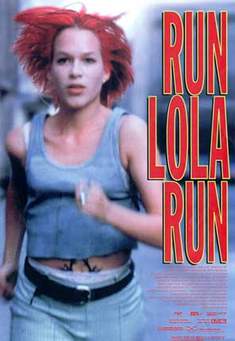
RUN LOLA RUN is a German import about Lola (Franka Potente), who gets a frantic phone call from her boyfriend Manni (Moritz Bleibtreu), and has only 20 minutes to find a large sum of money, or he will be killed by the drug dealer to whom he supposed to deliver the money. Lola rushes to save Manni from the drug dealer, and from himself — he plans to hold up a store if she cannot get him the money. When she interacts with people on her way — and in her way — we get glimpses of what their lives ahead will hold. Lola runs to the bank where her father to ask him for the money. But he has his own problems. She does not make it in time, and the result is tragic. But Lola is determined not to let that happen again. All of a sudden, we are back in her apartment and she is getting Manni’s call again. Everything starts over, but with tiny differences that have huge consequences for Lola and Manni and for the people around them. It takes three tries before Lola’s running is over.
DIRECTION STYLE
Run Lola Run is a 1998 German thriller film. The film was written and directed by Tom Tykwer, and starring Franka Potente as Lola and Moritz Bleibtreu as Manni. Tykwer’s story is fast and breath-taking from the beginning until the last minute. The arrangement of scenery and properties in Run Lola Run is quite detailed and well organized. The mise-en-scene has a lot of external scenes from the streets of Berlin. In reality, the city is mostly crowded but as a choice of the director, as a manner to emphasise Lola and Manni’s distress, the streets are calmer and serene. The Internal scenes include Lola’s house, her father’s bank, the supermarket where Manni and Lola rob, the subway and the casino. All scenery was decorated in accordance with the reality.
The director has chosen to utilize non-conventional camera techniques. Run Lola Run uses two different and distinct cameras; a camera with high resolution (35mm) and low resolution. The high resolution camera is used for Lola and Manni’s scenes whereas the low definition camera is used in scenes which don’t involve the couple (Film Education, 1999). Manni and Lola’s scenes have visibly better definition which contrasts with, for example, her dad and his mistress’ scene, where the definition is low and granny. Tykwer wanted to give the scenes without Lola and Manni a sensation of illusion, resembling it as an artificial world as in a video game. The scenes rich in lively colours gives to Franca Potente and Moritz Bleibtreu’s characters the sensation of what it’s happening to them is real.
STORY
Lola receives a frantic phone call from her boyfriend Manni, a bagman responsible for delivering 100,000 Deutsche Mark. Over the phone, Manni relates the story that he was riding a subway to the drop-off location of the money and panicked at the sight of ticket inspectors. He exited the train and realized that he left the money bag in the car as he got off; he last saw a homeless man examining the money bag as the train pulled away. Manni explains that he is meeting his boss in 20 minutes, and that he will be killed unless he has the money. Manni is about to rob a nearby supermarket to secure the funds. Lola implores Manni to wait for her, and decides to ask her father who is a bank manager for help.
Lola hangs up and runs down the staircase of her apartment building past a man with a dog. At the bank, her father is shown having a conversation with his mistress, who informs him that she is pregnant. When Lola arrives, she has a conversation with her father, which degrades into an argument and him telling her of his affair and that she is not his biological daughter. Lola runs to meet Manni but arrives too late, and witnesses him entering the supermarket with a gun. She helps him rob 100,000 marks from the supermarket, but upon exiting the store, they find it surrounded by police. Surrendering, Manni throws the money bag into the air, which startles a police officer who shoots Lola in the chest.
The events of the film restart from the moment Lola leaves the house, only this time, she trips over the man with the dog. Lola now runs with a limp; her arrival at the bank is delayed, allowing her father’s mistress to add that Lola’s father is not the father of her unborn child. A furious Lola overhears the conversation, takes a security guard’s gun, holds her father hostage, and secures the 100,000 marks by robbing the bank. She evades police and is able to meet with Manni in time, but Manni is run over by a speeding ambulance Lola had distracted moments earlier.
The film’s events restart once more. This time, Lola leaps over the man and his dog, arriving slightly earlier at the bank and missing the opportunity to ask her father for help. She wanders aimlessly before entering a casino, where she exchanges all of the cash she has (about 100 marks) for chips, with which she plays roulette. She bets all of her earnings on the number 20, which wins. Roulette pays 35 to 1, so she wins 3,500 additional marks. She immediately puts all of her chips (3,600 marks) back on 20 and wins again – 126,000 marks. She gathers all of the money into a bag and runs to where Manni will be meeting his boss. Meanwhile, Manni spots the homeless man from the subway passing by on a bicycle with the money bag. Manni chases him down and takes the money bag by holding the homeless man at gunpoint. Lola arrives to witness Manni handing off the money to his boss. Manni joins Lola, who is disheveled and perspiring. As they walk along, Manni casually asks her what is in her bag.
EDITING
The fast editing, the sounds and music add action to the film. For example the red telephone ringing, the dialogue between Manni and Lola and the tick of the clock, all these diegetic sounds bring the audience’s attention to the silver screen. An important element to the film though is the soundtrack. The techno music conducts the spectator to follow Lola’s rhythm and share her anxious feelings. The soundtrack is another indicative that Lola is reliving the same circumstances. Like mentioned before, Lola is displayed to different occasions which force her to change her course and act dramatically different between them. Through the non-diegetic sound, the audience experience three different “running”. For example, at her first attempt to save Manni, the beat is stronger and faster, compared to the third, where the music is softer. It gives the sensation that in her last attempt, Lola’s more assertive about what she is going to do.
CONCLUSION
Run Lola Run keeps the audience attention from the beginning until the end through its original visual style and well selected soundtrack that combined generates an explosion of tension, adrenaline and suspense. The movie is bursting with postmodern elements which has gained its place as one of the great films from the genre and conquered the public with its twisted narrative, irregularity and discontinuity. Tom Tykwer’s awarded movie is a great option for those who enjoy appreciating cinema as art or simply enjoy a good action movie.

 Film Blog
Hai good work
LikeLiked by 1 person